
Login to read full article
The state of team effectiveness 2026: unlocking competitive advantage through team dynamics
Featured Post
| 360-Degree Feedback | Collective Advantage | |
|---|---|---|
| Insight | Individual competencies | Behaviours, attitudes and climate |
| Data collection time investment (50 Participants) | 125 hours (10 ratings per participant, 15 mins each) | 20 hours (25 mins each) |
| Benchmarking | None (internal only) | External, validated norms |
| Output audience | Individual & HR | Manager, Teams and Leadership |
In a world of complexity, almost all high value work in organisations is conducted in teams. It is why healthy collaboration is central to any company that wants to make a positive difference to customers and the wider world. It is also why culture – the psychological environment in which people work – is mission-critical.
> RELATED: Why psychological safety is mission-critical →
Team effectiveness is linked to several key performance outcomes, including improved decision quality, increased innovation and more effective task execution. Google’s Project Aristotle (2014) found that the most important contributing factor to highly effective teams was psychological safety. In other words, the researchers found that what really mattered was less about who is on the team, and more about how the team worked together. In psychologically safe environments, employees were less likely to leave, brought in more revenue and were rated as twice as effective by executives.
As organisations shift from measuring individual performance to assessing team performance, leaders need diagnostic tools that reveal how teams think, behave, and collaborate – not just how individuals perform. Here’s how Collective Advantage compares to traditional 360-degree feedback.
Both Collective Advantage and 360-Degree Feedback broadly speaking are leadership diagnostics, aiming to provide objective data on performance, and leveraging multiple perspectives with the goal of improving manager and team performance.
The results are used as a feedback tool, uncovering current strengths, development areas and potential blind spots, which can improve in the future with targeted action.
Nevertheless, Collective Advantage and 360s differ in a number of crucial ways. This article will unpack their differences to help you understand what each diagnostic tool offers, and when to use Collective Advantage over 360-Degree Feedback to make the most impact for your objectives.
Collective Advantage is our scientifically-validated psychological safety psychometric assessment that helps you to gain a robust measure of team effectiveness, as created and perceived by the manager and their reports.
Unlike individual assessments, Collective Advantage measures the shared norms, beliefs and behavioural climate that shape how teams innovate, learn, and challenge constructively.

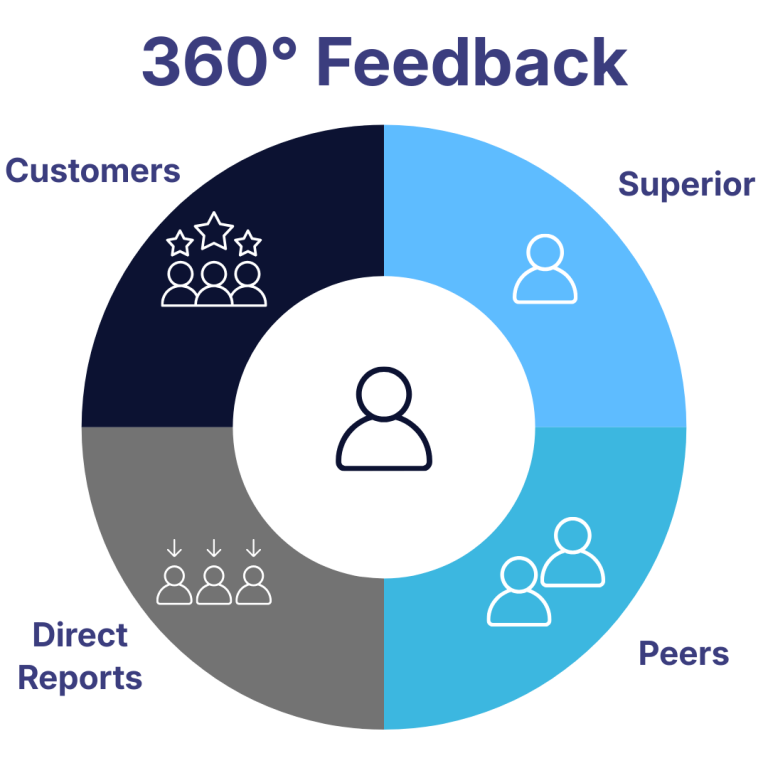
Typically a multi-response questionnaire, 360-Degree Feedback measures the performance of an individual by collecting responses from the manager, peers, direct reports – and potentially external clients and partners. It generates a holistic view of an individual’s performance and behaviours.
This increases self-awareness, and enables targeted development around an individual’s blind spots and hidden strengths to improve their performance and collaboration.
While 360s are excellent for assessing individual performance, they cannot reliably capture collective norms, shared experiences, or structural barriers within the team or organisation.
Here’s when to consider using our psychological safety assessment as an alternative to 360-Degree Feedback.
As a validated psychometric, ensure reliability, validity and credibility in your results.
Compare your organisation against external standards, not just relying on internal perceptions where results are open to collusion and typically gravitate towards the median results. Because most 360s are not normed or externally benchmarked, results often sit around the organisational “comfort zone,” making it hard to understand performance relative to high-performing teams elsewhere.
Analyse multiple perspectives on the team dynamics, and drill down beneath behaviours to the attitudes and perceptions driving them – something 360s cannot reveal. This enables deeper understanding of why behaviours show up and provides stronger opportunity for cultural change from the manager and their team.
Do individuals in the team trust their managers and each other? Do people feel able to share issues and concerns with their manager and each other? How confident are they to suggest ideas and challenge the status quo? How does this affect risk mitigation and decision making in the team?
Traditional 360s often result in dense, multi-page reports that require hours of HR interpretation. Collective Advantage is built for speed and clarity, providing managers with a “heat map” of team dynamics and immediate, actionable recommendations to improve performance.
Receive clear actions and recommendations from the data, without spending the time understanding, cross-examining and interpreting many data points.
> RELATED: Walk through our Collective Advantage demo report →
Unlike 360s, Collective Advantage is designed for manager and team conversations, not just HR. By involving the whole team in the follow up, each individual sees their feedback being discussed and turned into action, increasing team accountability and ownership, and improving engagement and transparency.
Setting up the psychometric for your team structure and interpreting the datasets is fully managed, eliminating administrative burden and the need to develop specialist capability and train employees which is common for 360s.
As a scalable and efficient tool, Collective Advantage takes ~25 minutes per person and can be deployed across entire teams, business units, or organisations.
While Collective Advantage and 360-degree feedback serve different purposes, they can be complementary when sequenced correctly. Many organisations use 360s as a standard development and feedback tool; adding Collective Advantage provides a team climate lens that a 360 does not capture.
However, timing is everything. To avoid “survey fatigue” and data collection overload, we rarely recommend running both simultaneously. Instead, a high-impact approach is to lead with Collective Advantage to establish a comprehensive picture of psychological safety and team climate. Once this “cultural soil” is understood, a 360-degree review can be introduced later to help managers refine the specific emotional intelligence (EQ) and leadership competencies needed to sustain and improve that environment.
Together, Collective Advantage and 360-Degree Feedback offer a complete picture of both the leader’s skills and the team’s collective reality.
Use our demo walkthrough to see the Collective Advantage insights on team effectiveness for yourself.
Go to demo
© Matthew Syed Consulting 2026. All rights reserved. Registered in England and Wales. Mindset Analytics Ltd. trading as Matthew Syed Consulting. Company No. 12234380. VAT No. 333252530. Matthew Syed Media Ltd. Company No. 08760326. VAT No. 176704488.
Privacy Policy
| Cookie Policy
Website by Eldo™