




Lack of psychological safety in executive leadership teams is surprisingly common

You are about to enter a leadership meeting with a sinking feeling in your stomach. Maybe you are dreading an emotionally exhausting discussion or are just fed up with the lack of collaboration and alignment.

Blaming, subtle undermining, power plays… a climate of distrust and lack of psychological safety in leadership teams is surprisingly common. The People + Science Boardroom Psychological Safety Benchmark 2020 -2021 (Australia) found that only 4 out of 10 top leaders feel psychologically safe and just 3 out of 10 report high levels of trust with fellow decision-makers[1].

The impact of of psychological safety on executive leadership teams

The impact of psychological safety in leadership teams on organisational performance is considerable. The People + Science study has shown it is a lead indicator and precursor of quality decision-making at leadership level. Boards that work effectively as teams have 800% greater impact on profitability than any one well-qualified board director[1].

In this article, we explore what happens when leaders lack trust in each other or in the most senior person in the team, and we share some techniques for building trust and psychological safety in leadership teams.

shutterstock 1725017218 dark and soft edit

What is psychological safety

Psychological safety in leadership refers to a team climate characterised by interpersonal trust and mutual respect in which people are comfortable being themselves[2].

When people feel that they can speak up, share ideas, and ask questions openly, they are better able to deal with conflict and they collaborate more effectively.

> RELATED: Register your interest for our upcoming Psychological Safety Workshops for Leaders →

How does psychological safety relate to trust?

Research identifies several elements of trust that are critical for positive interpersonal relationships and effective collaboration in organisations[3]:

Rational Trust

  • Competence
    Do others see me as competent and knowledgeable?
  • Predictability
    Do others see me as consistent, dependable, and reliable?

Emotional Trust

  • Benevolence
    Do others see me as kind, empathetic, and discreet?
  • Integrity
    Do others see me as acting in accordance with acceptable values and ethics, including honesty and fair treatment?

What happens when trust and psychological safety in leadership teams are missing

Leaders withdraw

When leaders are worried about getting blamed for problems or being treated unfairly if they voice a concern, they may not raise issues or admit mistakes. This often leads to avoidance of contentious topics or uncomfortable discussions. Directors retreat to their areas of expertise, valuable contributions become inhibited, issues are concealed or ignored, and groupthink reigns supreme[4].

The profoundly impactful decisions made at the most senior levels require candour and taking interpersonal risks, which can only happen in a psychologically safe environment.

AdobeStock 646665157

The impact of this can be devastating. Patisserie Valerie, a UK listed company, collapsed in 2019 following a £40m financial statement fraud perpetrated by a supplier with the collusion of five finance staff members. For these staff members, it was “easier to fiddle the numbers than admit to bad results [to the executive chairman, Luke Johnston].”[5] Luke Johnston undermined psychological safety in his company and lost £225 million of his personal wealth as a result[6].

Lack of focus on enterprise goals

Most of an organisation’s competitive value is created when functions come together as capabilities (e.g., marketing, consumer analytics, and R&D, together developing innovation capability)[7]. When top leadership teams act primarily as a collective of individuals focussed on achieving individual goals, it prevents them from collaborating effectively to achieve shared goals and delivering that value. When leaders don’t consistently act in each other’s best interest, information doesn’t get shared, and problems don’t get solved[4].​

AdobeStock 1574273137

At the National Institute of Health (NIH), competition between different departments meant that it was taking too long to bring effective medicines to the public. Patients were dying as the various teams worked in silos to try to be first to the finish line. The NIH formed a new organisation, AMP (Accelerating Medicine Partnership), to tackle silos, share expertise and information, and facilitate collaboration across teams as well as with external partners. This led to dramatic advances for the NIH, beyond the scope of any competitor[8].

Drop in innovation and flexibility

There is significant evidence that a climate of psychological safety and trust is key to being able to innovate and adapt[9]. Barbara Fredrickson at the University of North Carolina has found that positive emotions like trust and confidence help us become more open-minded and resilient, increasing solution-finding and divergent thinking – the cognitive processes underlying creativity[10], [11]. Leaders who see each other as competent, dependable, ethical, and focussed on shared goals, are more likely to come up with new ideas and respond quickly to changes.

AdobeStock 524179238

Google, arguably one of the most innovative companies of our time, identified psychological safety as the first of five essential ingredients of high-performing teams. In their research, they found sales teams with the highest levels of psychological safety outperformed their goal by an average of 17%, while those with the lowest levels of psychological safety missed their goals by an average of 19%[12].

How can leaders build greater trust and psychological safety at the executive level?

Building psychological safety among leadership teams is vital and there are a range of ways you can achieve this.

1. Evaluate the current climate in the leadership team

Evaluate the level of psychological safety in a leadership team by reflecting on and rating the questions below on a scale of 1 to 5 (5 being highest).​​

With these questions answered, the next step is to understand the levels of trust within the team. To do this, create a relationship map.

Ask each leader to complete a survey evaluating different aspects of the relationships they have with their fellow leaders, focussing on competence, benevolence, predictability, and integrity.

Identify clusters of high and low trust. Understanding the underlying reasons can help focus on where to strengthen trust in the team.

> RELATED: Take a guided tour of a team report from our psychological safety psychometric, Collective Advantage →

2. Encourage accountability, not blame

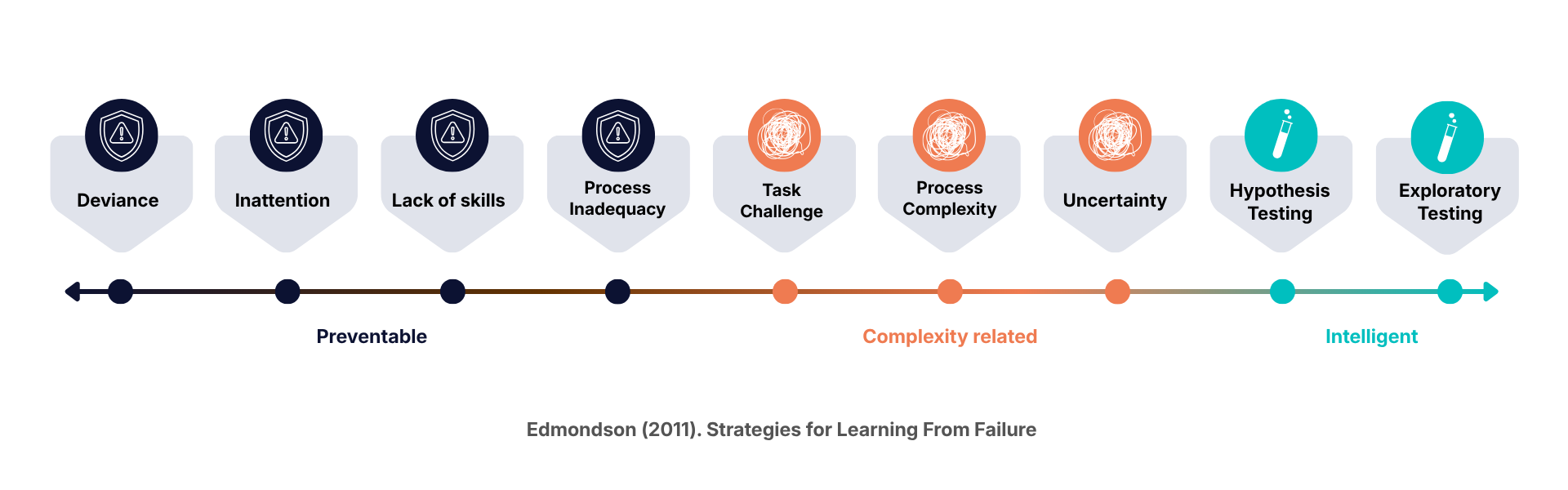
Amy Edmondson, Professor of Leadership at Harvard Business School, describes a continuum of activities that portray reasons for failures and negative outcomes, spanning preventable, complexity-related and intelligent[13].​

Reasons for negative outcomes

Learning From Failure Graphic Edmondson (1)

Some avoidable errors are more “blameworthy”, such as those due to deviance, whilst ‘intelligent’ failures, such as exploratory testing, are more “praiseworthy”.

To increase innovation, it is important to create environments where it is safe not to get things 100% right the first time so that people can explore, learn, and test things out. Role model the language and behaviours you want to foster by reframing problems or challenges as an opportunity to grow: “What can we learn? How can we improve?”

3. Build trust through words and actions​​

Create a simple communication charter outlining agreed ways of communicating in meetings

Everyone contributes
No cutting over people
Build on ideas instead of criticising
Offer a constructive way forward

Make time to develop or strengthen social connections

Talk about life outside of work, e.g. spend time discussing people’s evenings or weekends, a favourite programme, or a book recommendation. It is important to consider that some people may prefer to keep this more private, however
Acknowledge different pressures, whether additional family responsibilities, financial or other issues. Sharing these can create opportunities to build connections and support each other

Why psychological safety is essential in executive leadership teams

Psychological safety and trust amongst senior leaders is critical for running an innovative, agile, and profitable organisation, enabling them to share ideas freely, raise tough issues, collaborate better, and create competitive value.

Such an environment requires effort to build and maintain but can ultimately help people and ideas thrive.

References:

[1] Grant, C. (2021). Board Briefing: Boardroom Psychological Safety Impacts Decision Making. Women on Boardshere.

[2] Edmondson, A. C. (1999). Psychological Safety and Learning Behavior in Work Teams. Administrative Science Quarterly, 44(2), 350-383.

[3] Dietz, G. & Den Hartog, D. N. (2006). Measuring Trust Inside Organisations. Personnel review, 35(5), 557-588, here.

[4] Dempsey, S. (2021). Dealing with Toxic Behaviour in the Boardroom. Australia Institute of Company Directorshere.

[5] Marriage, M. & Beioley, K. (2019). Patisserie Valerie Report Talks of Fake Invoices and Ledgers. Financial Timeshere.

[6] Brennan, N. M. (2022). Is a Board of Directors a Team? Irish Journal of Management, 44(4), 5-19, here.

[7] Carucci, R. Velasquez, L. (2022). When Leaders Struggle with Collaboration. Harvard Business Reviewhere.

[8] Conner, C. (2014). Why Most Collaborations Still Fail (And 5 Ideas for Turning the Equation Around). Forbeshere.

[9] Edmondson, A.C. (2018). The Fearless Organization: Creating Psychological Safety in the Workplace for Learning, Innovation, and Growth, first edition, Hoboken, NJ: John Wiley & Sons.

[10] Delizonna, L. (2017). High-Performing Teams Need Psychological Safety: Here’s How to Create It. Harvard Business Reviewhere.

[11] Positive Emotions and Psychophysiology Laboratory. University of North Carolina Chapel Hill, here.

[12] Rosovsky, J. (2015). The Five Keys to a Successful Google Team. Re-Work with Googlehere.

[13] Edmonson, A. C. (2011). Strategies for Learning from Failure. Harvard Business Reviewhere.​